
 Português
 Deutsch
 English (UK)
 Español
 Français
 Italiano
 日本 (日本語)
 中国大陆 (简体中文)
Getting Started with Digital Printing: What is a DFE and Why Fiery Makes a Difference
If you’re new to the print world, you may have come across terms like “digital front end”, “RIP”, “workflow software”, and others. Digital printing can feel like a world of complex techy terms and big buzzwords.
But you’re just trying to answer a simple question:
How do I produce high-quality prints on time without wasting resources?
Let’s break it down in plain language—What digital printing actually is, what a Digital Front End (DFE) does, and why Fiery® is such a popular choice to run the show.
Why digital printing is such a big deal
Digital printing is basically the “on-demand” side of the industry. Instead of creating metal plates like traditional offset printing (think of the black-and-white movies where they “go to the presses” with a news article), with digital printing you send a digital file directly to a modern, high-tech press.
That brings some very real advantages:
- Fast turnarounds:
No plate-making, no long setup. You can go from PDF to printed sheets in minutes, not hours. Perfect for rush jobs, last-minute changes, and short campaigns. - Cost-effective short runs:
Need 50 brochures or 200 postcards instead of 20,000? Digital printing shines here. You only print what you need, when you need it. - Easy personalization:
Names, barcodes, addresses, versions, languages—digital makes it possible to customize each piece with variable data printing (VDP). That’s huge for targeted marketing and personalized customer experiences. - Less waste, more flexibility:
Because you don’t have to commit to large runs, you avoid boxes of outdated collateral. Update artwork as often as you like and keep your content fresh.
In short, digital printing gives you speed, flexibility, and the freedom to say “yes” to more kinds of jobs.
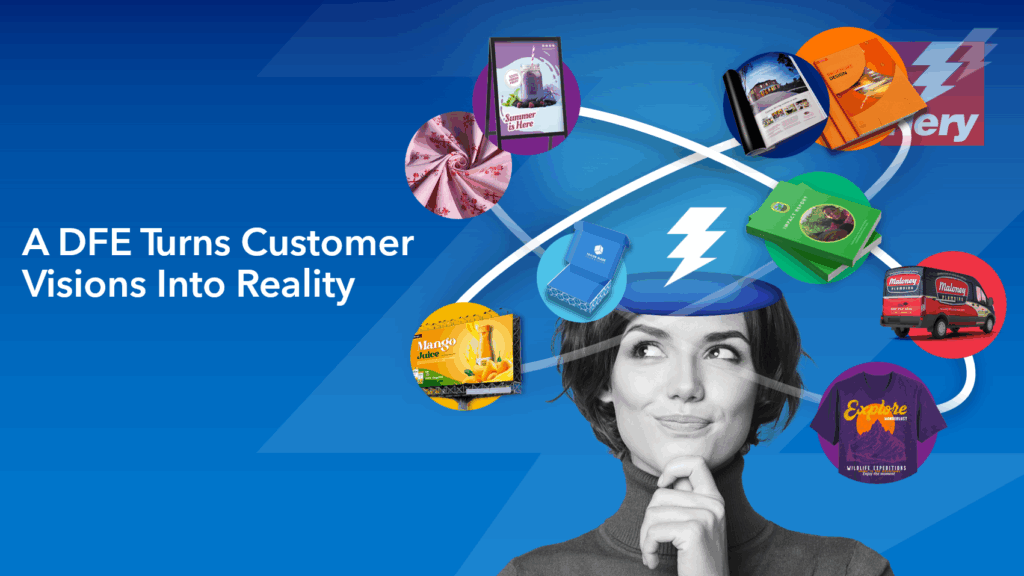
So what is a DFE, really?
The Digital Front End (DFE) is the brains of the operation.
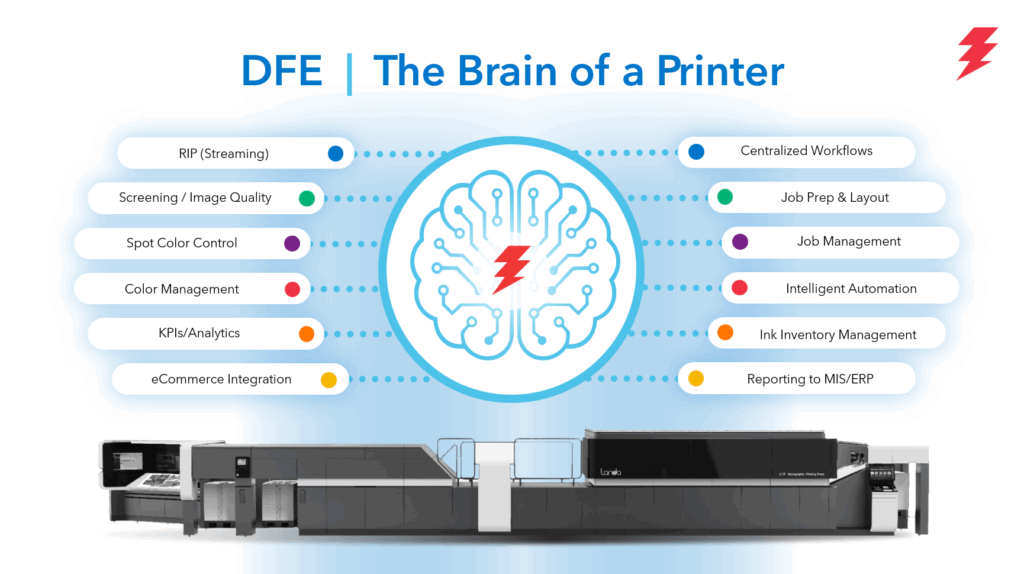
A DFE is a specialized combination of software and hardware that:
- Interprets print files (PDFs, VDP, PDLs) and prepares them for high‑speed production
- Converts files into rasterized, printer‑ready data optimized for the press
- Manages color processing, calibration, and profiling for consistent output
- Controls imposition, media selection, and finishing‑related print settings
- Automates job handling through queues, scheduling, and job tickets (e.g., JDF)
- Schedules and queues jobs to keep the press running efficiently
- Acts as the central control hub between the workflow and the production press
Think of it as mission control for your print room.
What the DFE actually does for you?
- RIPs files fast:
The DFE converts pages into the tiny dots the engine will print (this is called “raster image processing”, or “RIP ping”). A strong DFE keeps up with the engine so the press isn’t sitting there waiting. - Keeps color consistent:
It applies color profiles and calibration so your brand colors look right today, tomorrow, and on reprints. - Automates the boring stuff:
Imposition, booklets, tab layouts, media selection, routing to the right tray or press—these can all be automated through presets and workflows. - Gives operators control and visibility:
Operators can see what’s printing, what’s queued, and what’s waiting. That makes it easier to prioritize rush jobs and keep things moving.
Without a solid DFE, a powerful press can still feel slow, inconsistent, and hard to manage. With the right DFE, you unlock the full potential of your machine – and your investment.
Why Fiery is often the DFE of choice?
Now, where does Fiery® come in?
Fiery DFEs are used across millions of devices worldwide, from small in-plant operations to high-volume production environments. They’re known for three big things: color, speed, and control.
1. Color you can trust
If you’ve ever printed a job and thought, “That’s not the red we promised,” you already know how important color management is.
Fiery helps you:
- Match brand colors using profiles and spot-color tools
- Keep color stable over time with calibration and verification tools
- Handle different media (coated, uncoated, envelopes, labels) while staying as consistent as possible
Bottom line: what you approve on screen is much closer to what you see on paper, and reprints actually match.
2. Performance that keeps the press busy
Fiery is built to RIP complex jobs quickly, even when you’re dealing with:
- Heavy graphics
- Variable data campaigns
- Long documents or mixed media jobs
That means the press spends less time waiting and more time printing. More uptime, fewer bottlenecks.
3. Workflow tools that make life easier
Fiery isn’t just a “print” button—it’s a full workflow hub.
You can:
- Create hot folders so files dropped into specific folders are automatically printed with the right settings
- Use presets for your most common job types (e.g., tri-fold brochure on glossy, saddle-stitched booklet, tabbed manual)
- Manage multiple engines from a single interface with Fiery Command WorkStation®
For new operators, this structure and visibility makes it easier to learn. For experienced ones, it removes repetitive tasks and frees up time for more value-add work.
Putting it all together
If you’re just getting started in digital printing, here’s the simple picture:
- Digital printing gives you fast, flexible, short-run and personalized work
- A DFE is the smart control center that turns your files into accurate, efficient print jobs
- Fiery DFEs help you see the difference in color quality, turnaround time, and day-to-day productivity
Instead of fighting with settings and reprints, you get a predictable, repeatable workflow that scales as your volume and complexity grow.
When you pair a capable digital press with a Fiery DFE, you’re not just buying equipment—you’re building a production platform you can grow on to get the most out of your investment in a press.
That’s when you unlock the true power of digital print.
Learn more about Fiery DFEs in this YouTube video!