

 English (US)
 Português
 Deutsch
 Español
 Français
 Italiano
 日本 (日本語)
 中国大陆 (简体中文)
Why Cybersecurity is No Longer Just an IT Problem in Print
When most people think about cybersecurity threats, they picture banks, healthcare providers, or email hosting services. Rarely do they think about a production print facility.
That’s a mistake.
Today’s production print environments process some of the most sensitive information in business: customer statements, financial documents, healthcare communications, direct mail campaigns, account information, and other regulated data.
In other words, modern print operations aren’t simply producing documents. They’re acting as custodians of highly valuable data.
As cyberattacks become more sophisticated and compliance expectations continue to rise, print providers must view security as a core operational responsibility. The good news is that today’s production print technologies offer powerful tools to help protect both systems and customer information – provided those tools are properly implemented.
The real threat isn’t the printer
Production print environments face many of the same cybersecurity risks as any enterprise network.
Ransomware, malware, unauthorized access, credential theft, data exposure, unpatched systems, and insecure network services are all potential attack vectors. What makes print unique is not the list of threats, but what’s at stake when those threats succeed.
A single security incident can expose customer data belonging to dozens or even hundreds of clients. The resulting consequences often extend beyond operational disruption to contractual obligations, regulatory compliance requirements, and long-term damage to customer trust.
And the risks might not even come from IT infrastructure, but rather from physical access to the production network.
The overlooked dangers: physical access and workflow connectivity
Production floors are busy, shared environments. Operators often work across multiple systems, leaving devices active but unattended. Shared credentials, removable storage devices, and serviceable hardware can create opportunities for data exposure that bypass traditional network defenses entirely.
At the same time, print workflows are more connected than ever.
Jobs enter through web-to-print portals, hot folders, cloud services, automated workflows, MIS and ERP integrations, and customer submission systems. Each connection is necessary for business efficiency, but each also creates another entry point into the environment.
The challenge isn’t connectivity itself. The challenge is that many of these integrations are configured once during installation and then receive little ongoing scrutiny.
Why the DFE has become a critical security component
At the center of this production ecosystem sits the Digital Front End (DFE).
Traditionally viewed as the central hub for job processing and colour management, the DFE has also become one of the most important security components within the print workflow.
A modern DFE manages:
- User authentication
- Job processing
- Workflow integrations
- Communication between systems
- Access control
- Data storage
Because the DFE touches so many parts of the workflow, its security posture can have a significant impact on the overall environment.
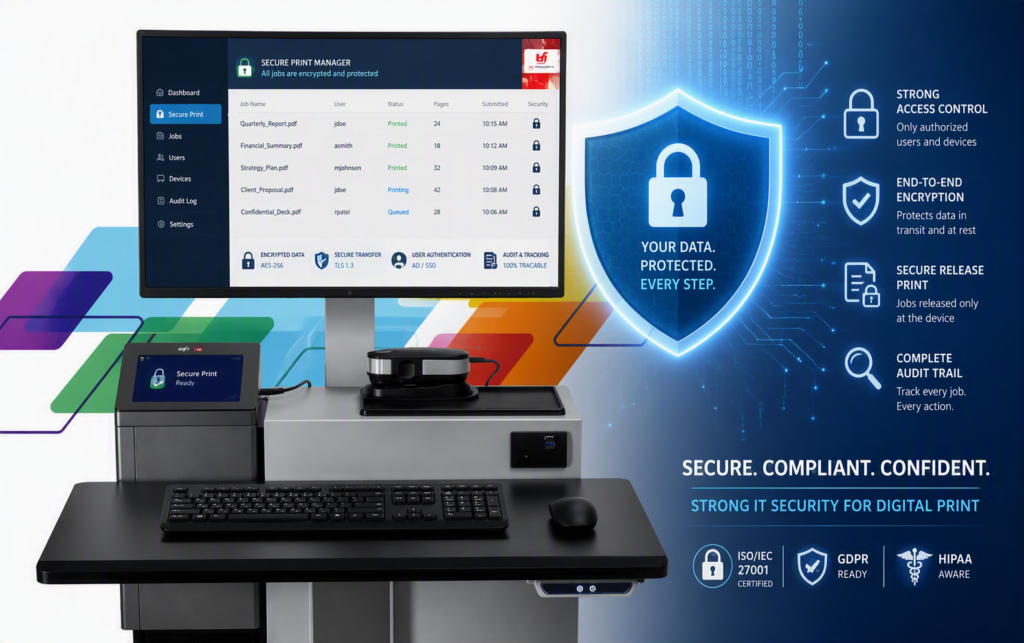
Strong security begins with fundamentals. DFEs should support hardened operating systems, timely software updates, controlled network ports, secure integrations, and centralized identity management.
Advanced, security-oriented platforms such as Fiery DFEs support capabilities including:
- Role-based access control
- LDAP and Active Directory integration
- Microsoft Entra ID Single Sign-On
- Multi-factor authentication
- IP filtering
- Port management
- Digitally signed security updates
These capabilities help organizations strengthen access controls while reducing the risks associated with excessive permissions and unmanaged user accounts.

Storage security requires looking beyond the DFE
One common misconception is that securing the DFE automatically secures all production data.
In reality, the DFE and the print engine typically maintain separate storage systems.
While the DFE may hold queued, archived, or processed jobs, many print engines also temporarily store job data and rasterized page information on internal drives managed independently through OEM firmware and system controls.
That distinction matters.
An organization may have strong retention and deletion policies on the DFE while unintentionally leaving recoverable customer data on the press itself.
Effective storage security should include:
- Encryption of stored data
- Restricted physical access to storage devices
- Secure deletion procedures
- Administrative access controls
- Clearly documented retention policies
- Verification of storage behavior on print engines
Fiery DFEs protect data at multiple levels. Data at rest is encrypted with AES-256 — the same algorithm approved by the U.S. government for protecting classified information — while secure erase aligned with NIST SP 800-88 sanitizes data at end of life, and the optional Disk Drive Security Kit and High Security Kit add hardware-backed safeguards including TPM-based boot drive encryption.
Protecting data in motion

The security of stored information is only half the equation.
Production workflows continuously move data between prepress systems, DFEs, print engines, and business applications. Every transfer presents an opportunity for interception if communications are not properly protected.
Modern environments should rely on encrypted protocols such as TLS 1.2 and 1.3, IPsec, and LDAPS to protect print jobs and credentials as they move through the workflow. Fiery DFEs support OpenID Connect (OIDC) for federated authentication to Fiery WebTools, validated with Microsoft Entra ID, so administrators can bring DFE access under the same single sign-on and multi-factor authentication policies that govern the rest of the enterprise.
How much protection can hardware really provide?
Modern hardware has dramatically improved security. Storage encryption, secure boot technologies, Trusted Platform Modules (TPMs), and physical port controls make many traditional attacks significantly more difficult than they were a decade ago.
But hardware alone is not a security strategy.
No amount of encryption can compensate for:
- Weak passwords
- Shared administrator accounts
- Excessive user privileges
- Open network services
- Poor patch management
The most resilient organizations recognize that cybersecurity is layered. Hardware protection works best when paired with strong identity management, disciplined patching practices, network segmentation, and documented operational procedures.
Cybersecurity is now a competitive advantage
Modern print customers increasingly expect their print providers to demonstrate the same security rigor they require from cloud providers, software vendors, and enterprise IT partners.
Security is no longer just an operational concern. It is becoming a business differentiator. Organizations that invest in identity management, encryption, secure workflows, patching discipline, and controlled access don’t simply reduce risk: they build trust.
And in an industry built on handling other people’s information, trust may be the most valuable asset of all.